Browse Items (166 total)
Sort by:
Kent Street Houses, 1929-1953
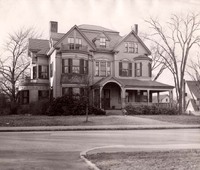
The College began using 240 Kent Street as the first of the houses in 1929, followed by No. 241 (1944) and No. 232 (1947), to help ease the housing shortage.
With the completion of Dix and Morse Halls in 1953, the College sold the majority of its…
With the completion of Dix and Morse Halls in 1953, the College sold the majority of its…
Longwood House, 1920-1963
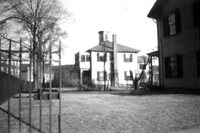
During the First Endowment Campaign (1920-1924), Simmons purchased Longwood House (1920) on Pilgrim Road, with single, double, and triple rooms. Many rooms were wedged under the eaves, necessitating creative closets and furniture arrangement.…
Main College Building, 1904-Current
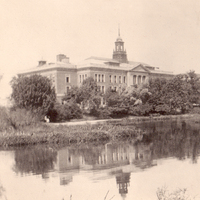
Construction for the original Main College Building (MCB) was completed in September 1904. The West Wing was added in 1909, and the East Wing was added in 1929.
During the PRIDE program, renovations were carried out at the MCB from 1975-1980,…
During the PRIDE program, renovations were carried out at the MCB from 1975-1980,…
Mesick Hall, 1961-2026
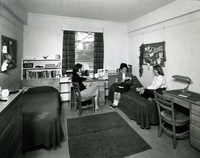
Named in honor of Jane Louise Mesick (1884-1967), the College's fourth dean (1925-1949), Mesick Hall (1961) could house 129 students. It received cosmetic upgrades in the early 2000s.
Located on the Residence Campus, Mesick Hall will be removed…
Located on the Residence Campus, Mesick Hall will be removed…
Morse Hall, 1953-2026
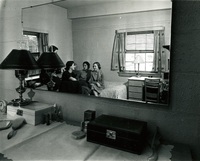
Morse Hall was completed in 1953 and was designed by the architectural firm the Austin Company. Morse Hall could house 120 students and was named after Frances Rollins Morse (1850–1928), a charter member of the Corporation (1901-1922).
Located on…
Located on…
North Hall, 1907-2026
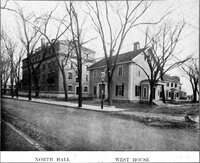
To make way for its second permanent dormitory, North Hall, the College physically moved Students’ House (Hastings) from No. 86 Bellevue Street to No. 4 Short Street in 1906. Construction for North Hall was completed in 1907, just before the lease of…
One Palace Road, 2002-Current
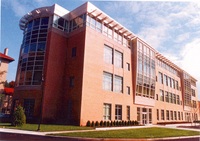
The College began construction of One Palace Road, and an accompanying underground parking lot, in 2001. The new building was, in part, driven by the pressing need to integrate the Graduate School of Social Work on the Academic Campus, which had been…
Park Science Center, 1972-2023
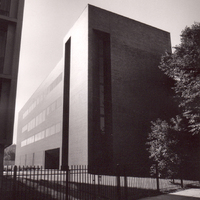
The Park Science Center was built in 1972 as part of Simmons’ 25-year expansion plan.
The Center became representative of the College's larger goals: a commitment to advancing careers in science for women; accommodation for enrollment increases;…
The Center became representative of the College's larger goals: a commitment to advancing careers in science for women; accommodation for enrollment increases;…
Peterborough Street Houses, 1907-1936
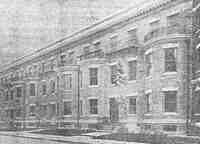
Two adjoining houses on Peterborough Street were leased as dormitories in 1907, with a door cut between them. Two more houses were leased on Peterborough Street the following year, and students in these houses received a rebate on their board in…
Pilgrim House, 1925-1963
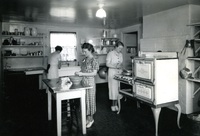
Pilgrim House (1925) was purchased through funding from the First Endowment Campaign. It was known as the “experiment” or “practice” house for students in the Household Management course.
During the course, students were required to live in…
During the course, students were required to live in…