Nursing at Simmons, 1970s - 1990s
From its inception, the nurses who came from Simmons strove to work with other healthcare providers and human services workers to promote a community-oriented model of care. The 1970s through the 1990s saw growth in program offerings for health care professionals as well as an expansion of the facilities students trained in on campus.
In 1972, Simmons unveiled the Park Science Center, which allowed all students of the sciences to learn together in one building for the first time. It included four floors with modern laboratory equipment, including state of the art nursing simulation labs.
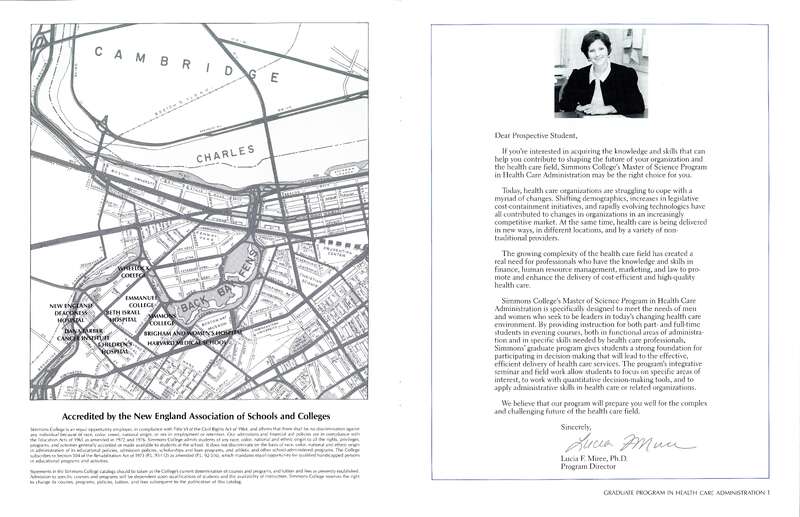
The Master of Public Health Nursing was not the last inter-disciplinary graduate nursing degree offered by Simmons. In 1986, a catalog for the Graduate School of Health Studies (GSHS) advertised an MS in Health Care Administration. The degree was offered as a collaboration between the Departments of Management, Economics, and Nursing, preparing students to work in health care settings with a variety of skills. The catalog includes the testimonial of student Sally Hartshorn, RN, who is a full time student and part time private duty nurse: “You can work and go to school at the same time - that way, you can incorporate what you learn into your present position… It is not like other schools - not like a factory. I feel like I belong here at Simmons.”
These interprofessional graduate degree programs resonate with Simmons Nursing's long history of a community-minded approach to health care. The philosophy of the graduate program stressed "the human need for lifelong learning; the advancement of a humanistic and scientific basis of nursing practice; maintenance and improvement of health and prevention of illness; the preparation of committed, accountable professionals; and the dynamic interaction of humans with biophysical and cultural factors in the process of adapting to internal and external environments.”
As the nursing department continued to move into the 1970s and the landscape of nursing in the United States continued to grow and change, Simmons introduced expanded program offerings to include training to become nurse practitioners.
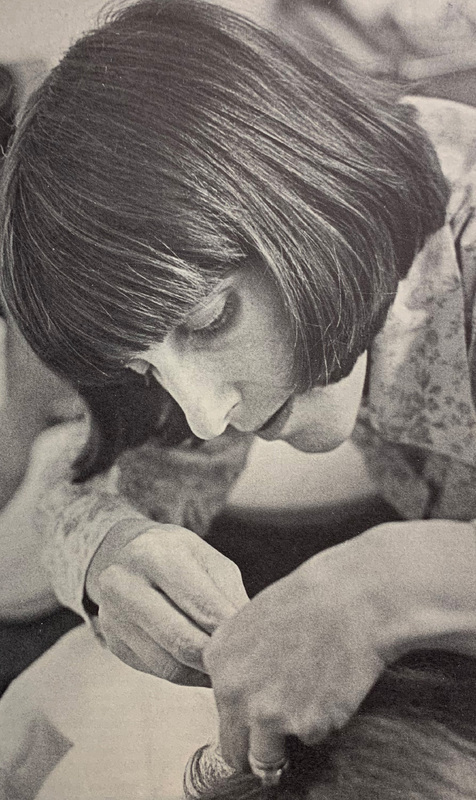
Before the introduction of a Nurse Practitioner graduate program, Simmons alum were becoming what the Late Winter/ Early Spring 1977 issue of the Simmons Review describes as "the new breed of nurse." Marion Schonbrunn Nadel '66, featured in the article, worked as a nurse practitioner, using medical skills to examine and diagnose a patient, and using the skills of a nurse to take the time to listen to her patient.
At the time of the article's publication, the graduate program had been proposed, but not yet implemented. The Review comments, “The Department of Nursing has proposed a Graduate Program in Primary Health-Care Nursing which will lead to a Master of Science Degree in Nursing. It will be a collaborative program of the Department of Nursing and of the Peter Bent Brigham Hospital Ambulatory Nursing Services. It will prepare adult nurse practitioners for expanded nursing roles.”
The nurse practitioner movement formed in response to the criticism of the delivery method of medical care in the United States. Reminiscent of the public health movement in which the nursing program at Simmons originated, Americans became more interested in community-based care rather than just hospital care.
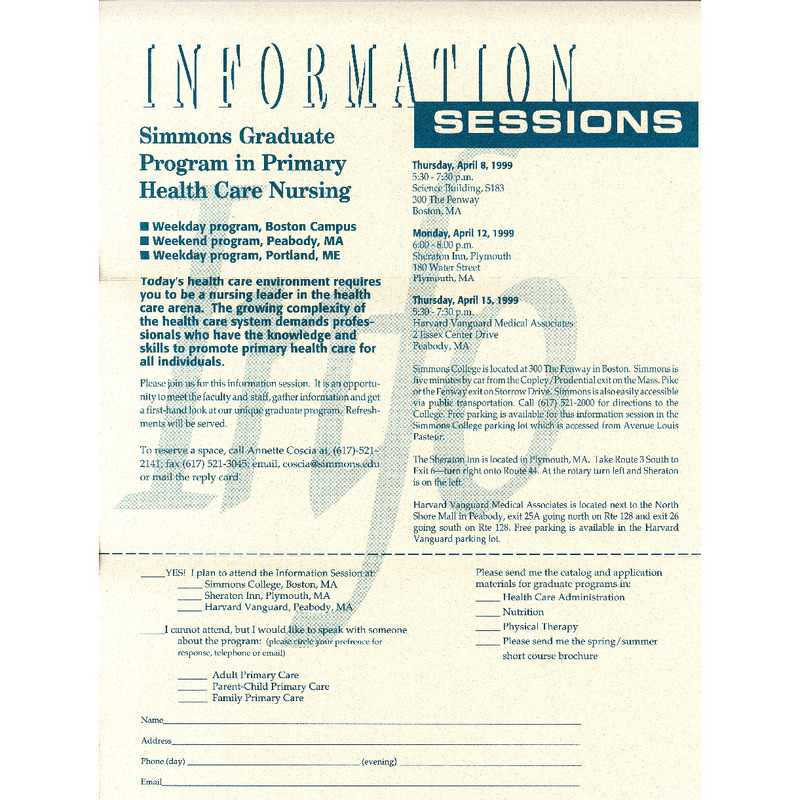
The nurse practitioner program was met with much success, and Simmons continued to implement measures to improve the skills of nurse practitioners while trying to remain as flexible as possible. One such measure was the Simmons and Westbrook College Partnership in Primary Health Care Nursing, a program in which students could pursue a graduate nurse practitioner degree from Simmons on the campus of Westbrook College in Portland, Maine. Inaugurated in 1994, the program offered courses on weekends, and was designed for nurses to continue their education into the advanced nurse practitioner role “with minimal interruption to their professional and personal lives.” The program also offered flexibility for students to take courses on the Boston campus, and concentrate in either adult, family, or pediatric health.
Courses for nurse practitioners continued to adapt and change to meet the healthcare needs of the current moment. For example, short course offerings in 1999 included HIV Pathogenesis: Understanding the Spectrum; Feminism and Health Care; and Herbal Medicine: Alternative Treatments Explored. Simmons nurses learned about the landscape of health care in the context of the time in which they received their training, making them apt and adept clinicians.