Early Days of Nursing at Simmons, 1900s-1920s
Simmons College, founded by John Simmons in 1899, was established so women would be able to obtain the education needed to earn an independent livelihood. At first, it offered Bachelors of Science degrees and certificates in Household Economics (including courses in teaching), Library Studies, Secretarial Studies, and General Science. Nursing, however, was soon to follow.
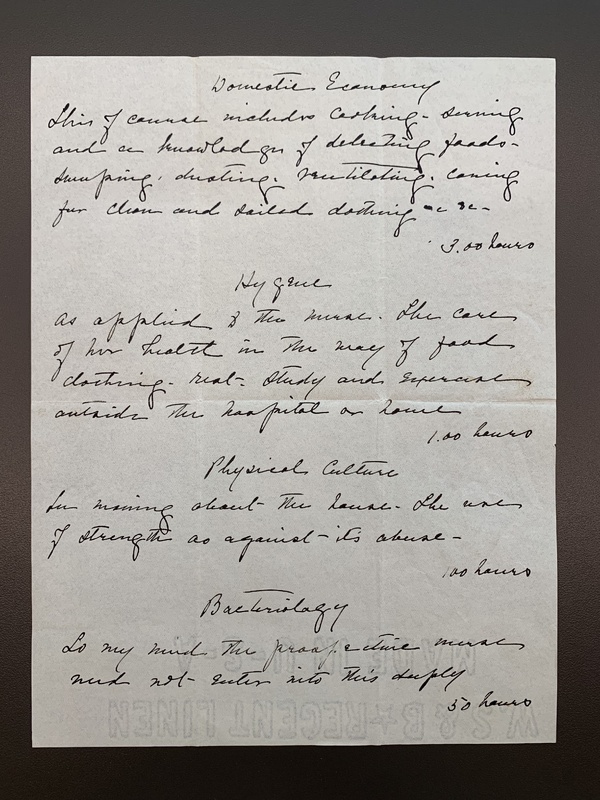
At the turn of the 20th century, it was very rare indeed for colleges to offer training in nursing; the vast majority of nurses were educated at hospital training schools. Student nurses would work in their hospital for a period of two years in exchange for room and board as well as their training. In 1902, Simmons professors began exploring the feasibility of offering academic programs in Nursing and solicited suggestions from area professionals. One nurse, Linda Richards at the Taunton Insane Hospital, wrote back and recommended coursework in domestic economy, hygiene, physical culture, bacteriology, anatomy, physiology, and household chemistry as critical to success in the field.
At the inception of the nursing program at Simmons, it felt important to collaborate with area hospitals. The school first engaged with Mass General Hospital and Boston Children’s Hospital in 1904 “for the purpose of encouraging the movement toward the better education of nurses.” [President’s minutes, 1904] At the graduation ceremony at the Training School for Nurses at the Children’s Hospital in June 1904, Simmons Professor W. Sedwick remarked on this new arrangement, where nurses in training would be able to work “with their hands as well as their brains.”
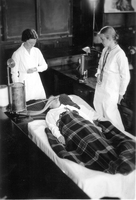
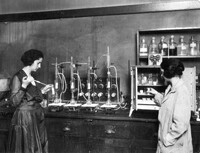
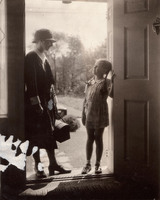
In its founding decades, Simmons offered several different options for nurses and nursing students. One program consisted of a single term, designed for students of hospital training schools to gain a more solid training in scientific subjects that would help them as nurses. Courses included anatomy and physiology, bacteriology, chemistry, food values and cookery, and sanitary science. Another program, completed in partnership with Mass General Hospital and Children's, allowed for students to engage in foundational scientific coursework at Simmons, and gain practical experience at the hospital in their community. This one year program helped nurses specialize in Public Health Nursing; the first term was spent in the classroom at Simmons, and the second was spent in the field. Classes at Simmons included public health nursing, municipal and industrial sanitation, biology in sex education and sociology, nutrition, and philanthropic problems.
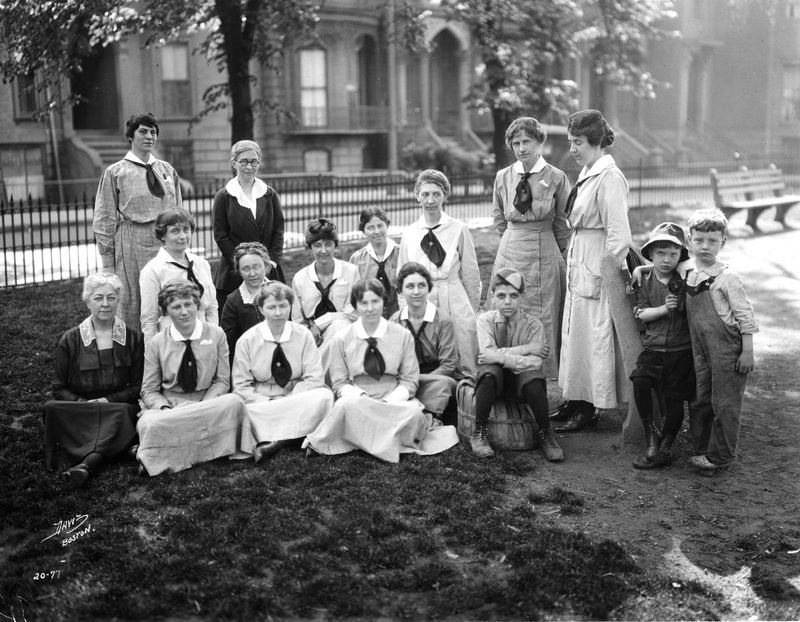
Anne Strong, who served as the director of the Public Health Nursing Department (later renamed School of Public Health Nursing) from 1917-1925, worked to implement Public Health Nursing training into the curricula at Simmons. A pioneer in the field of Public Health Nursing, she was known for her success in correlating theory and practice, in developing field work, and in establishing standards of field practice for Public Health Nursing students. Under her leadership, the nursing program at Simmons came to be named the Simmons School of Public Health Nursing, centering the experiences of working for proactive healthcare in the community.
Strong believed in the intelligence and readiness of her students, and further believed that the nursing program at Simmons ought to prepare women to be qualified healthcare leaders. Following their studies at Simmons, according to Strong, students should be able to supervise, teach, organize, or administer nurses and healthcare professionals.
Anne Strong seemed to be universally beloved by her students. She was described as having "much initiative, a democratic spirit, and a most gracious personality.” She was also admired by her contemporaries in the Public Health Nursing field, one remarking following her passing in 1925, "In her death the profession of nursing has suffered sorely, her friends in the profession and outside it, still more."
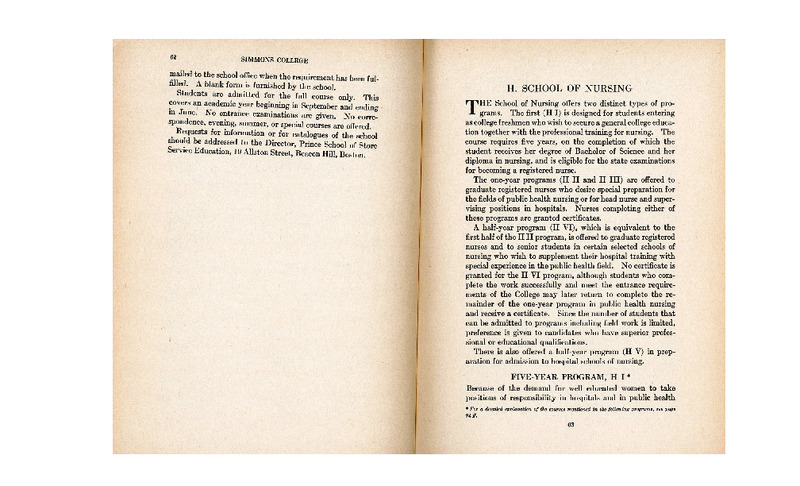
Beginning in 1918, the Simmons School of Public Health Nursing offered a revolutionary five year programme for student nurses. The programme was designed for students who had recently graduated high school and were ready to further their education, but were not yet old enough to enroll at a hospital training school. The program featured two years of classroom instruction at Simmons, followed by a two-year clinical experience at an area hospital. The final year allowed students to choose a specialization that would prepare them to be a leader in the Public Health Nursing field. According to the landmark pamphlet by Josephine Goldmark, published in 1923 detailing nursing and nursing education in the United States, 13 universities and 3 colleges had developed bachelor's nursing degree programs. As one Simmons pamphlet recalls: “Graduate nurses who hold college degrees are greatly in demand… This programme consequently offers a distinct advantage, since it combines technical training with college work arranged to furnish the scientific foundation in modern nursing.”
It is unlikely that the five year programme coincidentally originated around the same time as World War I and the flu pandemic of 1918. Helen Wood, director of the nursing program from 1934-1946, believed that Anne Strong conceptualized the five year programme in the Boston Common during World War I. She recognized growing need for nurses, a need that did not promise to slow following the war, and that there were numerous young women finishing high school who had a strong interest and promise in the field of nursing, but were too young to be admitted to a hospital training school. “It was obvious,” wrote Helen Wood, “That if we did not get them on graduation from high school, they would enter some other field. But they could enter college at seventeen and in a five-year program would become graduates when legally old enough to become registered nurses.” Indeed, the five-year programme was devised as a solution for Simmons to be able to proactively contribute to a shortage in public health nurses.