Henrietta Derman (1882–1954)
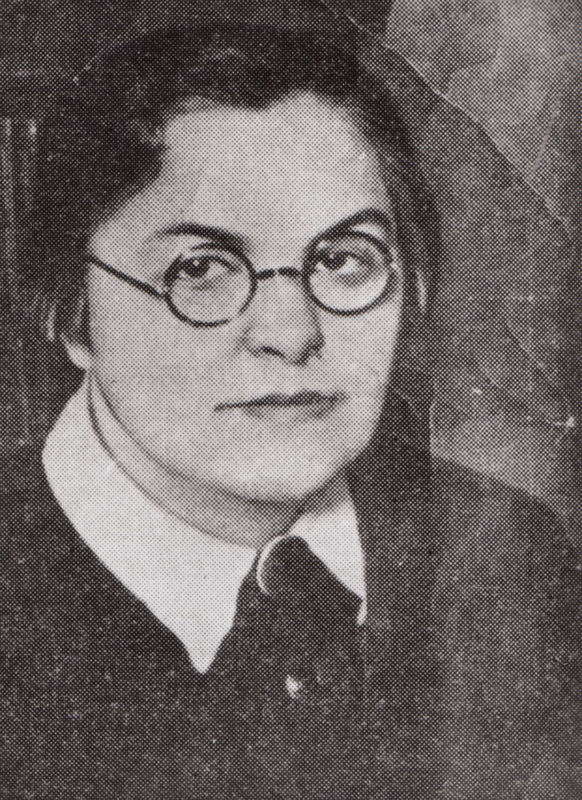
Henriette Karlovna Derman (1882–1954) represents an early example of Simmons’ international influence in the field of librarianship. Born in Riga, Latvia, in 1882, then part of the Russian Empire, Derman studied at the Lomonosov Women’s Gymnasium and graduated with honors (Richardson, 2000, p. 110). After passing the examination to become a home teacher, or tutor, in 1903, she moved to Moscow to enroll in higher women’s pedagogical courses, graduating in 1905, after which she returned to Riga and married Vilis Derman, a teacher. She and her husband were later arrested for revolutionary activity but released due to lack of evidence (Richardson, 2000, p. 110).
The couple emigrated to Germany by way of Finland in 1914, and, after being expelled from Germany that same year, immigrated to the United States by way of Sweden and Denmark. In late autumn 1914, they arrived in Boston, where Derman found work as a tutor and in 1916 enrolled in Simmons College as a “special condition” student to study librarianship (Richardson, 2000, p. 110). Although she completed her studies at Simmons in 1917, Derman did not receive her degree at that time. The college awarded her the Bachelor of Science degree nearly two decades later. Correspondence from 1937 indicates that Simmons faculty raised the matter and arranged for the degree to be conferred, recognizing her professional accomplishments and continued connection to the institution (Derman, 1937).
![Letter from Derman to Jane Donnely [June Donnelly]](https://beatleyweb.simmons.edu/s125-a250/files/fullsize/082f0e20f0a8db9b2877226aa892783b.jpg)
After completing her studies, Derman gained further practical experience in the United States. From 1918 to 1921, she worked at the Harvard University Library (Richardson, 2000, p. 110) and then at the Library of Congress cataloging Russian collections (Martel, 1921). These early experiences in major American libraries reinforced her Simmons training and helped prepare her for leadership roles when she returned to Europe. Derman returned to Moscow in 1922 where she quickly assumed prominent roles in the Russian library system. At that time, Russia was still confronting widespread illiteracy: the 1897 census found that 73 percent of the population age nine or older was illiterate, and by the October Revolution (1917), 14 million of the country’s 17 million illiterate people were women (Richardson, 2000, p. 111). Because formal educational opportunities remained limited, efforts to expand literacy increasingly relied on libraries as accessible centers for self-education and public learning (Richardson, 2000, p. 112). In this context, libraries were seen as an important means of bringing knowledge to a much broader reading public (Richardson, 2000, p. 115). Expanding literacy required not only teaching people to read, but also providing access to books, organizing collections so they could be used effectively, and training librarians to guide new readers. The development of librarianship as a structured profession was therefore closely tied to broader efforts to make education accessible on a large scale (Richardson, 2000, p. 112). Derman’s work in organizing libraries, improving cataloging systems, and helping to establish formal training programs for librarians places her work within these efforts (Richardson, 2000, p. 110).
![Letter from Harriet G. Eddy to Jane Donnely [June Donnelly]](https://beatleyweb.simmons.edu/s125-a250/files/fullsize/87c7d8d55bb0b3757c987397f61df798.jpg)
Derman played an active role in the organization and leadership of major Russian library institutions. In 1921, she gave a talk in Moscow at the Library Institute on “Librarianship in America,” emphasizing how the Library of Congress subject cataloging system could be adapted for use in Russian libraries (Richardson, 2000, p. 110). She continued this work through her involvement in national and international professional gatherings, including organizing the first All-Russian Library Congress in 1924, where she spoke on the centralization of cataloging, and later participating in the First International Library and Bibliographic Congress in 1929 (Richardson, 2000, p. 110). Her most significant institutional contribution came in 1930 when she became the founding director of the Moscow Library Institute, the first independent establishment devoted to the higher education of librarians (Richardson, 2000, p. 110). She went on to write extensively about the institute’s activities, help establish evening courses for librarians, and expand training, including a department for children’s librarianship. She also remained active internationally, taking part in conferences in Italy and Spain (Richardson, 2000, p. 110).
Derman’s career shows how Simmons served as a starting point for internationally active professionals in the early twentieth century. The training she received, combined with her work in major American libraries, helped prepare her to shape library education in Russia. Her later recognition by Simmons through the awarding of her degree underscores the lasting connection between Simmons and a student whose work extended its influence internationally.
References
Derman, H. (1937, February 2). [Letter to June Richardson Donnelley]. Simmons University Archives (Guide to the Graduate School of Library and Information Science records, 1904–1998 collection, Box 35, Folder 31), Boston, MA.
Martel, C. (1921, May 24). [Letter to June Richardson Donnelley]. Simmons University Archives (Guide to the Graduate School of Library and Information Science records, 1904–1998 collection, Box 35, Folder 31), Boston, MA.
Richardson, J. V., Jr. (2000). The origin of Soviet education for librarianship: The role of Nadezhda Konstantinovna Krupskaya, Lyubov’ Borisovna Khavkina-Hamburger, and Genrietta K. Abele-Derman. Journal of Education for Library and Information Science, 41(2), 106–128. https://www.jstor.org/stable/40324059