Service Learning: An Overview
Roots of Service Learning at Simmons
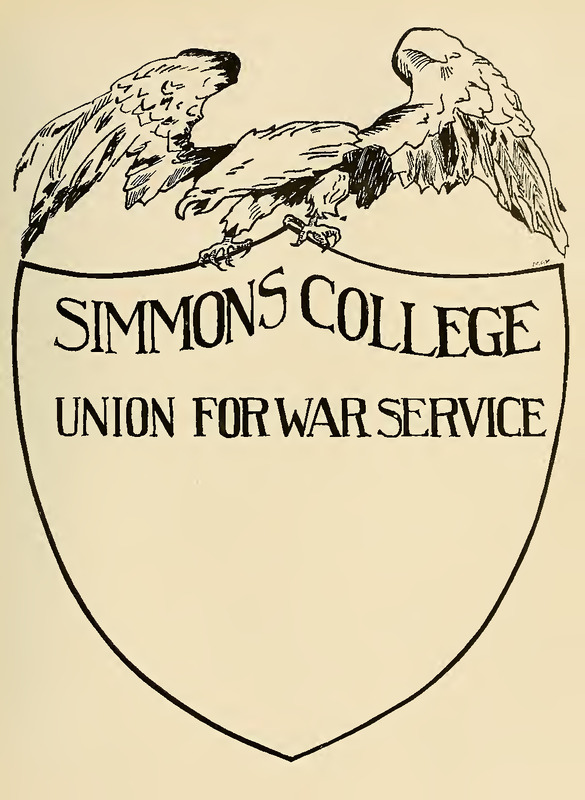
Simmons students participated in many community service efforts, especially under the supervision of socially conscious leaders such as Dean Sarah Louise Arnold (1859-1943), and Jeffrey Brackett (1860-1949), founder of the Simmons School of Social Work. During the first world war, the “Simmons College Union for War Service” was established to keep track of the numerous student and faculty engagement in wartime efforts. Later, the Union provided financial support for organizations and individuals associated with Simmons who conducted emergency wartime work. Union projects included running the Simmons Farm Unit and maintaining a volunteer branch at the Volunteer Service Bureau of the Boston Metropolitan Chapter of the Red Cross.
Field training with affiliated local institutions was incorporated into Simmons' course curricula from the beginning. These partnerships led to notable instances of community service, such as the nursing field placements during the 1918 influenza pandemic.
World War II
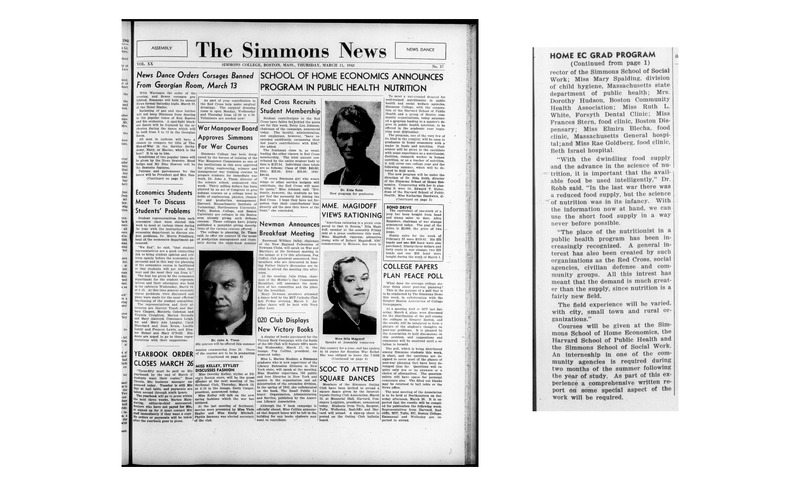
Simmons students continued showing up for their country and their community when they established the War Service Committee during World War II. Students rolled bandages, directed war stamp sales, and participated in first-aid classes and Red-Cross volunteer work. Simmons also established a Program of Public Health Nutrition in partnership with the Harvard School of Public Health which placed students as nutritionists in multiple local organizations to help communities make the most of their food in the midst of a supply shortage.
Social Relations Volunteer Program
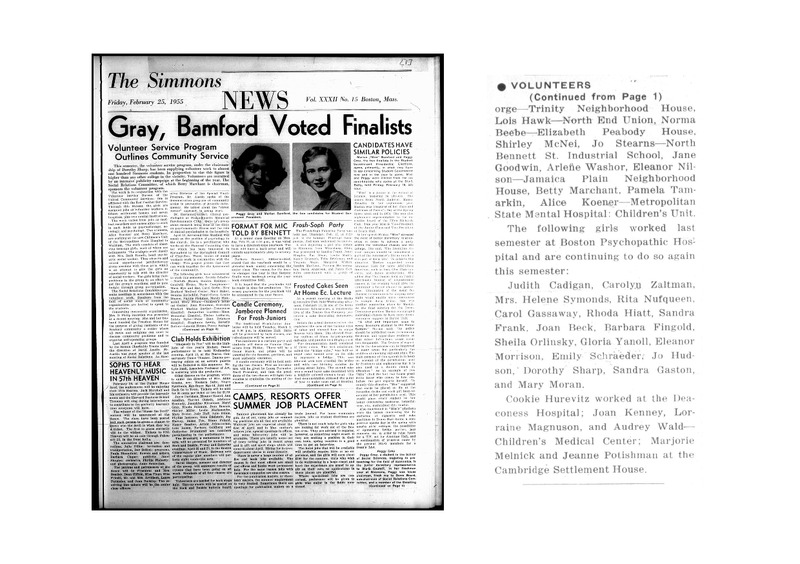
Between the years 1955-1970, the Social Relations Volunteer Program facilitated the placement of Simmons student volunteers in local settlement houses (such as Jamaica Plain Neighborhood House, Norfolk House, Goodwill House, Cambridge Settlement House, Peabody House, North End Union, Trinity Neighborhood House), hospitals (Children’s Medical Center, Deaconess Hospital, New England Medical Center, Mass. Memorial Hospital, and Peter Bent Brigham Hospital), mental health facilities (Boston Psychopathic Hospital, Metropolitan State Mental Hospital), and schools (North Bennett St. Industrial School).
Program in Community Affairs
From 1970-1971, Simmons established the Program in Community Affairs which facilitated fieldwork placements for students in sociology courses. Students were placed in social and government agencies, schools, hospitals, churches, and community centers. In 1975, Simmons appointed its first Coordinator of Volunteer and Community Programs. Fifteen years later, in 1990, the College established the Simmons Institute on Women, Work, Family, and Social Change “to bridge the gap between theory and practice as it relates to women’s lives.” To broaden the institute’s mission of developing community partnerships to advance social justice and change, it was renamed the Simmons Institute for Leadership and Change (SILC) in 1994.
Community Service
The term “community service” first appeared in the 1987-1988 Simmons College course catalogue in the description for Edu. 343-1 Development of the Employability Plan and Issues in the Education of the Severely Impaired Learner. At the time, however, there was no formal integration of “service learning” as a pedagogy within the College, despite the frequency of community service efforts and in-class field placements.
Scott/Ross Center for Community Service
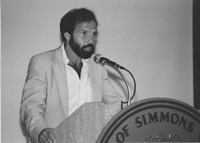
In 2000, the Scott/Ross Center for Community Service (S/R Center) was established “to help facilitate and promote community-based learning for Simmons students, faculty, and staff in the greater Boston area and beyond.” The S/R Center merged with SILC in 2016 under the umbrella of Simmons Community Engagement.
Renamed the Stephen D. London Center for Community Engagement and Social Justice in 2022, the London Center establishes partnerships with local community organizations, programs Alternative Spring Breaks along with other community service opportunities, and facilitates service-learning courses at Simmons. Faculty and instructors can apply to designate their courses as service learning by incorporating specific criteria into their course design.