Public Health Service Learning: Working for Health Equity
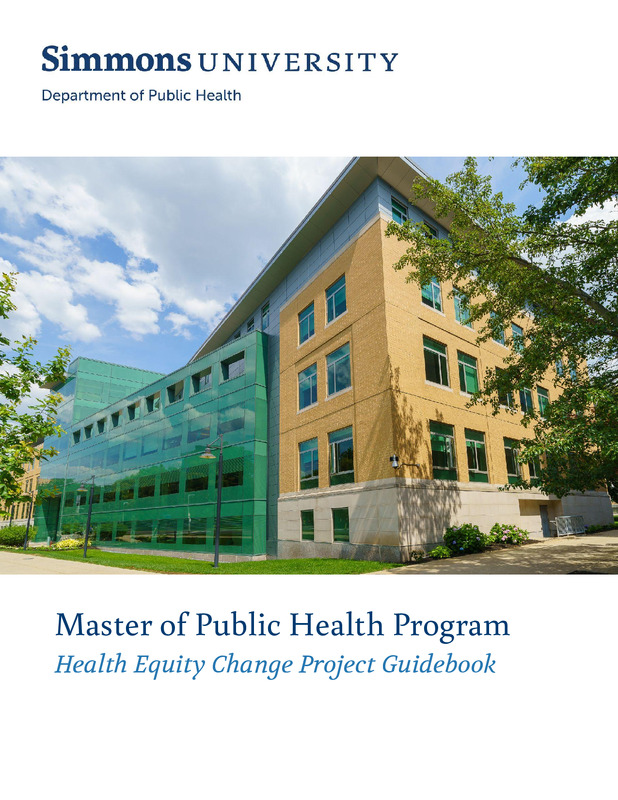
The Master of Public Health (MPH) program aims to develop leaders who can work for equity in public health. Service learning is an integral part of the curriculum: for the Health Advocacy, Community Organizing and Innovation course (MHEO465), students complete a placement that allows them to engage in community organizing or advocate for health equity, or both. Associate Professor Leigh Haynes directs the MPH program and teaches MHEO465.
Students bring together their service learning experience with analysis, research, and planning skills developed in other courses to produce a Health Equity Change Project that completes their MPH program. For the Health Equity Change project, students work with a public health professional and organization (which may be the same as their service learning placement) in a 150 hour practicum to build, implement, and assess a project addressing a health inequity.
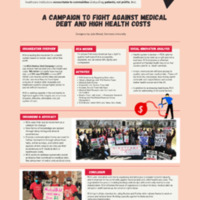
Simmons students’ service learning experiences illustrate the range of public health issues, as well as the many roles that students played. The Right Care Alliance (RCA) is a coalition of health care workers, patients, and community members aiming to make health care human centered rather than profit driven. Julia Wood (2023) worked on the RCA campaign against medical debt and high health costs by participating in a Boston Town Hall. There she presented her research findings and facilitated breakout group discussions.
Morgan Smith (2022) participated in the RCA's successful effort to have the Alzheimer's drug Aduhelm withdrawn due to its serious side effects and unproven efficacy. She worked with the RCA social media team and created, hosted and facilitated a study group on the FDA Accelerated Approval process that made Aduhelm available. Natalya Martins (2020), Siham Fatmi (2020), and Katrin Stinson (2021) worked on a protest against the high costs of insulin in Boston.
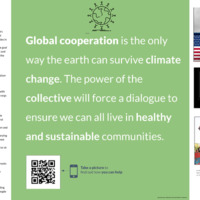
Simmons students also worked with Justice is Global, an organization "building a grassroots movement to win structural reforms to create an equitable and sustainable global economy." Annie Tse (2023) worked against the negative impact of nationalism on climate justice with coalition building, reaching out to Asian Pacific Islander (API) organizations with a teach-in. Sage Rosenthal (2023) collaborated with Justice is Global on climate change messaging, researching advocacy messaging and developing documents that volunteers could use.
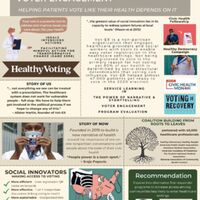
Finally, Brett Zimmerman (2023) worked with Vot-ER, "a nonpartisan, nonprofit organization working to integrate civic engagement into healthcare" by making it possible to register to vote in health care settings.
Student Interview: Hiba Hashim
Transcript
LK: So, I'm first going to ask you your name and your pronouns, when you graduated from Simmons and what you majored or minored in.
HH: Yeah, absolutely. My name is Hiba Hashim. My pronouns are she, her, hers. And I graduated from Simmons University with my MPH in May 2025, so last summer. And I majored in Health Equity.
LK: Amazing. Thank you. So, Hiba, what was your service learning placement and what class was it for?
HH: Yeah, absolutely. My service learning placement was with Justice Is Global and so I was working on a global vaccine equity campaign and it was for my MHEO465 class which was Health Advocacy and Community Organizing and I feel like it was the perfect fit because I got to address working with community partners and figure out how grassroots organization fits into public health work.
LK: Cool. So what kind of work did you end up doing as part of that placement?
HH: Yeah, I think Justice Is Global was such an interesting organization because it was made up of advocates. It was made up of policy makers, researchers, medical professionals. So, it was cool coming into the space and seeing like how in a field like public health different perspectives come together to work on one solution. And so, I specifically worked on the vaccine equity campaign. And this was in the context of the COVID-19 pandemic. So around like the 2020 time, 2021, vaccines, of course the world kind of shut down. And then these pharmaceutical companies were scrambling to come up with vaccines. And, Johnson and Johnson was one of the vaccine companies that was publicly funded. And so US taxpayer dollars went into this, the creation of this vaccine. And yet after the COVID pandemic kind of started dying down, at least in the States, a lot of these vaccines were kind of wasted. There were like about 2 million doses that were just thrown away which could have either been sent over to the countries in the Global South, or they could have been repurposed in some way. The technology also could have been shared with other countries and it wasn't. And so a lot of American citizens were upset. And, global citizens were upset. Because they needed the help and support. And so this pandemic continued a lot longer than it needed to. And that's kind of where Justice Is Global came in, and I came in. And we wanted to see how we can advocate to open up these like intellectual property rights and share our technologies. That way something like this doesn't happen in the future.
LK: Right, so it was kind of like a lot of policy work, it sounds like.
HH: Yeah, it was a lot of grassroots organization. We had a lot of people in DC for example put together rallies. And then they wanted to come up with like policy memos that we could send to local congressmen and women, and have them kind of advocate to amend the Bayh Dole Act which was like the law - one of the main laws - that kind of balances intellectual property rights with commercial interests, and to see how we can fix this for like future biomedical advances.
LK: Okay, cool. So what was your experience engaging with the communities that you worked with? Like what, yeah, what experience did you have kind of grassroots organizing either with the organization itself or with the communities they were trying to impact?
HH: I think it was really interesting. Because it's difficult work. It's like difficult to get people to care about it. As soon as the pandemic started going away and things started opening up, like, people wanted to forget. And so it's sometimes hard to be like, this is still important work. And I think public health is a lot of pre-planning. It's like thinking ahead. How can we be prepared for the next time this happens? And so sometimes that can just look like we're constantly following up with people. It was a lot of like practicing how to do cold calls and send emails. Putting together the rallies, for example, is a lot of project management and logistics work that I think as a young grad student you don't realize that it's just like it's more minute and like detail-oriented than you would expect it to be. And then it was also interesting to kind of shift our work online. I know that with the pandemic. Pre- pandemic a lot of things were in person and like rallies were really big. And then after COVID happened, people were a little nervous to gather together especially when we're working on vaccine equity. So, how do we shift, and communicate these important topics online and create public health campaigns that people will care about and actually engage with? And so that was kind of what sparked my interest, at least in my public health work - to see like where does that communications work come in.
LK: Cool. So yeah, I mean talking about kind of your own personal interest, what impact do you feel like the service learning had on your education at Simmons?
HH: I think the advocacy part one was really important to me. Because it just made me realize that you can't really speak for a community until you engage with them. So us like actually going out and asking people how, "How did like the policy process look like? Why are these acts in place to begin with?" We got to kind of see both sides of like "How is this process funded?", and then also speak to people in the Global South who are, who struggled a lot more with the pandemic and loss of life. And so that was something that I've definitely carried forward into my work in public health. I work at the Boston Public Health Commission right now and for a teen dating balance program and, we always make sure that we're not speaking for the teens and thinking that we know better than them. It's a lot of like "What do you think?" and like, "You speak first and then we'll figure out what resources we can put together." And so that definitely impacted my professional development. Secondly, I think it made me find my niche. I've always really been interested in writing and journalism and then I was premed and then I found public health and I somehow was able after this service learning project to find my niche and like how do you communicate scientific findings in a way that's engaging to like the average person and so finding like marketing and public health and something in between.
LK: Yeah. No, thank you so much. And you kind of you are already on to the next question, which is How has service learning at Simmons kind of informed your professional development, and how has it or how did it change your perspective moving forward from that, from that experience?
HH: Yeah, I think before the service learning, like as I was kind of, I worked with HERE4Justice as well, which is Simmons' student advocacy group. And so we did a lot of social media posts on various campaigns whether it was like maternal health or the pandemic. And it was kind of hard to see like we're so passionate about the work that we do. We've put together all these concepts, but we get 10 likes on Instagram or like a view on Facebook. And we're doing these Facebook Lives and no one's watching them. And so, it's been really interesting for me to see how we can communicate it in an innovative way. And so, like in my work now, we use memes, we use humor, we're on TikTok. And so it's been kind of cool to see how can we use communication strategies, like, commercially. Like for example, companies like Duolingo do a great job of seeming very engaging and open and like Gen Z. And so how can public health look like that? And my service learning project was like my first experience with that. And like how can we make toolkits and things that people will actually engage with beyond just public health professionals.
LK: Yeah, that's all yeah, sounds like really informative, a really informative experience for you and thank you so much for sharing all about it.
Student Interview: Katrin Stinson
What was your service-learning placement, and for what class?
KS: My service-learning placement was with Right Care Alliance. It was required for MHEO465 Health Advocacy, Community Organizing & Innovation.
What kind of work did you do as part of that placement?
KS: I was one of the many volunteer supporters at Right Care Alliance. Volunteer supporters took on whatever tasks were available in support of an activism event. I would attend meetings at the Cambridge office, meetings led by an event project manager. At the time I joined Right Care Alliance, an event to march at a Cambridge pharmaceutical that was charging market rates for insulin. The project manager was the Director of Organizing and Training. At each meeting the Director would run through a list of open tasks for the project and volunteers would sign up for whatever tasks they felt they could do. A task came up for location reconnaissance for the march sit. It was to identify parking locations, parking prices and on-site security. I visited the march site and took photos of garages and price lists and documented security personnel. Additionally, volunteers were asked to make signs to carry for the protest and to distribute flyers to publicize the march. I took part in both of these tasks. I printed and distributed flyers in my neighborhood and built signs.
What was your experience engaging with the communities you worked with?
KS: Distributing the flyers in my neighborhood was a challenge for me. I didn’t know my neighbors very well, even though I had moved in two years ago. So, I treated this task as an opportunity to introduce myself. I got a mix of reactions. Some neighbors politely listened to me and took my flyer and some refused to open their door to me. In the end, I don’t think any of my neighbors attended the march. I wasn’t disappointed in their response. I was disappointed that I hadn’t taken the time earlier to introduce myself to my neighbors, let them get to know me, which would have helped in making them feel comfortable in talking to me about the march.
What impact did service learning have on your education?
KS: I acquired an appreciation for the amount of work required to motivate people to participate in a civic action. Many people support many causes. However, there’s a significant gap between supporting a cause with a check and supporting a cause with activism. Also, I learned that activism begins locally. My public health studies introduced me to fantastic figures in the public health. However, I am now aware that those figures became fantastic through their relationships with others in their environment, i.e. family, friends, neighbors, colleagues, etc. Relationship development must be included in your plans for success. You simply can’t do it alone.
How has service learning at Simmons informed your professional development? How has/did it change your perspective moving forward?
KS: Service learning did inform my path in public health. After that experience with Right Care Alliance, I decided that I would be most productive and supportive of causes as an actor “behind the scenes”. There are many people who want to make social change, but such change requires, among other things, organization, planning, risk management, and communication. My skills are in those areas. Those are areas that will support me in my pursuits in public health.