Imagining the Architecture of Accessibility
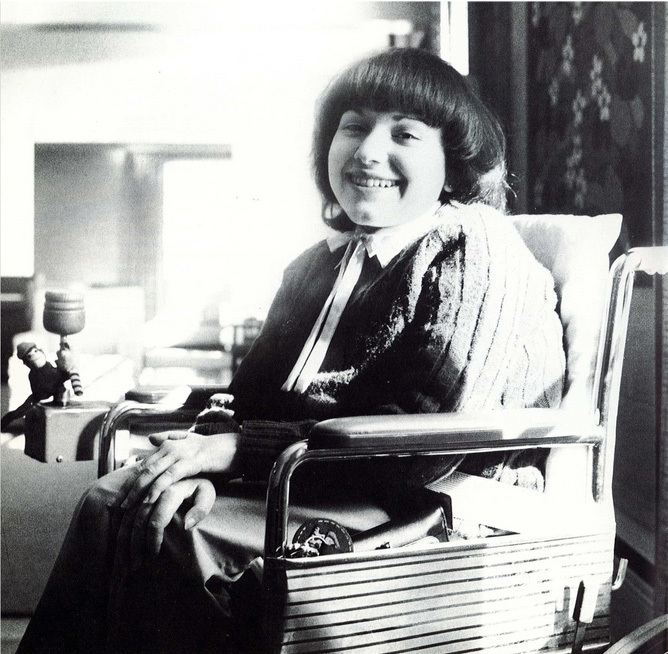
In 1980, the Simmons building renovation of 300 The Fenway was completed. In that year, Diana Little of the Simmons Review shared a story about a resident of Smith Hall during this time of transition. This resident’s name was Cyndy Miller. At that time Cyndy, a clinical psychology major, was living with Werdnig Hoffman disease (Spinal Muscular Atrophy), a genetic illness causing atrophy of skeletal muscles resulting in physical disability which required an electric wheelchair and physical assistance provided by human aides.
The 1980 renovations were planned just prior to the Rehabilitation Act of 1973 (Congress.gov, n.d.; U.S. Code, 2026), but at this time, the Massachusetts Architectural Barriers Act was in effect since 1968 (Commonwealth of Massachusetts, n.d.) leading the project to remove barriers to educational facilities for students like Cyndy. After facing barriers to accommodations from two other schools, Cyndy, found her place at Simmons as a result of the PRIDE (Program for Renovation and Income DEvelopment) construction planning which included a concrete ramp, refurbished elevators, new bathroom facilities, and repositioned telephones and water fountains.
President Holmes quoted the team leader of the Department of Health, Education, and Welfare as commending Simmons for its imagination and grace beyond compliance (Little, 1980, p. 14). Cyndy likewise expressed her gratitude in responding that “Simmons not only saw that I was an acceptable person to admit, but the College made a real effort to initiate and comply with the changes that I needed/” (Little, 1980, p. 14)

While accommodations required expediency, there were other aspects to consider concerning program accessibility in professional fields requiring certain competencies which would require a range of abilities. Little (1980) referred to a Supreme Court decision on the ruling of a nursing program not being required to change in order to accommodate a deaf student. Little was likely referring to the 1979 Supreme Court case Southeastern Community College, Petitioner, v. Frances B. Davis. The course made their decision to not require programs to change in order to make accommodations based on “academic and technical qualifications” not based “solely by reason of his handicap” nor on “affirmative conduct”, where patient or public safety is concerned (FindLaw, n.d.; Legal Information Institute, n.d.). As noted by Little, Anne E. Coghlan, Dean of Sciences, understood that official professional groups can best determine the degree of accessibility within each field, and affirmed that “to whatever extent is possible, handicapped persons will be accommodated in these areas” indicating that difficult decisions can be as fair as they are compassionate (p. 15).
Cyndy wrote appreciatively of her accommodations toward Simmons, her student aids, and of the MBTA Ride. Her fervent gratitude drove her aim to give back to the community in the field of psychotherapy to build a personal practice for mental health. As she was lifted up, so she in turn lifted others up.
References
Congress.gov (n.d.). H.R.8070 - Rehabilitation Act of 1973. https://www.congress.gov/bill/93rd-congress/house-bill/8070?s=2&r=10&hl=%22Rehabilitation+Act%22
FindLaw. (n.d.). Southeastern Community College v. Davis 442 U.S. 397 (1979). https://caselaw.findlaw.com/court/us-supreme-court/442/397.html
Legal Information Institute. (n.d.). Southeastern Community College, Petitioner, v. Frances B. Davis. Cornell Law School. https://www.law.cornell.edu/supremecourt/text/442/397
Little, D. L. (1980). Beyond the Aesthetics of PRIDE. Simmons Review, Spring 62(2) 11–17. https://simmons.access.preservica.com/uncategorized/IO_d90adfd7-9de6-4fb4-a986-739cda795558/
Commonwealth of Massachusetts. (n.d.) AAB rules and regulations. https://www.mass.gov/aab-rules-and-regulations
U.S. Code. (2026). 29 USC 701: Findings; purpose; policy. https://uscode.house.gov/view.xhtml?req=granuleid:USC-prelim-title29-section701&num=0&edition=prelim#sourcecredit