Honoring our Pioneers of the World War II Era
Launching a Wartime Effort
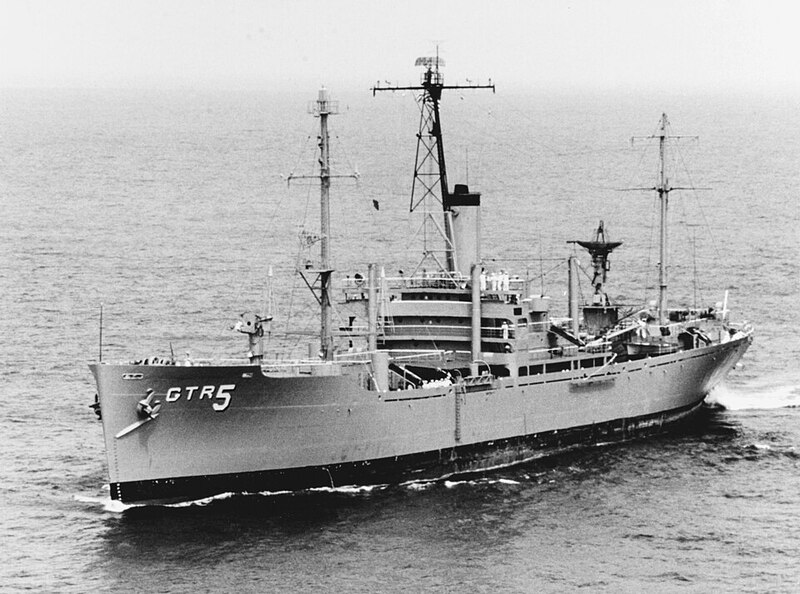
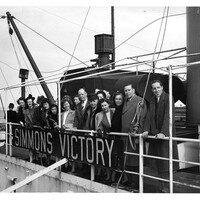
On April 6, 1945, a liberty ship named the S.S. Simmons Victory slid into the Willamette River in Portland, Oregon. Built as part of the massive wartime shipbuilding program, the ship was christened in the presence of a Simmons delegation. Janet Mecklem, the principal Simmons delegate, relayed a message from President Beatley:
"We at Simmons College are honored that a ship of the great Victory fleet is to bear our name. This occasion is a significant one for us because it symbolizes the role which our students, alumnae, and staff have played, and are continuing to play in the war effort." (S.S. Simmons Victory, 1945, p. 59)
The christening of a ship bound for hostile waters was an apt symbol for the college. Simmons had long insisted that education was a foundation for leadership and action. The stories of alumnae, Eleanor Midwood Coffyn, a naval officer, Dorothy Boulding Ferebee, a public health physician, and Dorothy F. Williams, a writer, demonstrate that their education at Simmons was not an end in itself; it provided the means to go out and change the world.
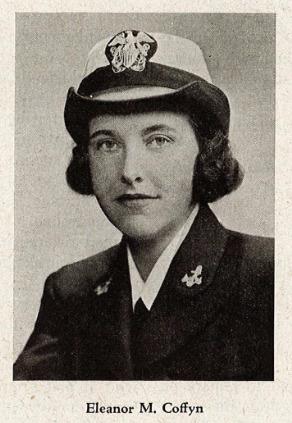
Eleanor Midwood Coffyn
Eleanor Midwood Coffyn first appears in the Simmons Review as a student reporter. In August 1942, she published "The Simmons Clubs and the War Effort," a survey of alumnae clubs documenting what Simmons women across the country were doing in response to the national emergency: nurses aides, blood donors, air raid wardens, salvage workers, and Red Cross volunteers. Coffyn's assessment was confident:
"the Simmons graduate is not shirking her responsibilities in civic defense and emergency activities. In fact, her contribution to the community and to the country is even greater and more desirable than ever at this time, and reflects the value and scope of her Simmons training."
By the following summer, Coffyn appeared in a commencement photograph as the newly elected President of the Alumnae Association.
In May 1944, Coffyn contributed to the Review with a first-person account of her entry into naval service as part of the Women Accepted for Voluntary Emergency Service (WAVES). The piece was titled "The Launching of a WAVE." Coffyn opened her account honestly, "Believe me, our hearts were beating fast … for the majority of us had left good positions and were entering a new and unknown field as beginners" (p.55). But she also recounts a sense of purpose that steadied her nerves, "The thrill of serving our country, of doing a worthwhile job and helping to get this war over with had already pervaded each one of us" (p.55).
Coffyn threw herself into training with something close to joy: the drills, the marching, the dormitory life, and the accelerated class schedule. Coffyn (1944) wrote, "Regular hours, excellent food, exercise and fresh air were agreeing with all of us … we had never felt better " (p.56).
After the completion of her training, she was assigned to Boston as Assistant Ship Controller, a position men had held previously, and brought to the job the same spirit that drove her to training: "The more we learn, the more fascinating the job becomes" (p.58).
Cofffyn (1944) closed the piece with an explanation for her own evolution: "Long ago Simmons emphasized service to the community and to humanity, so when this emergency occurred, it was second nature for those of us who were free to join up " (p.58).
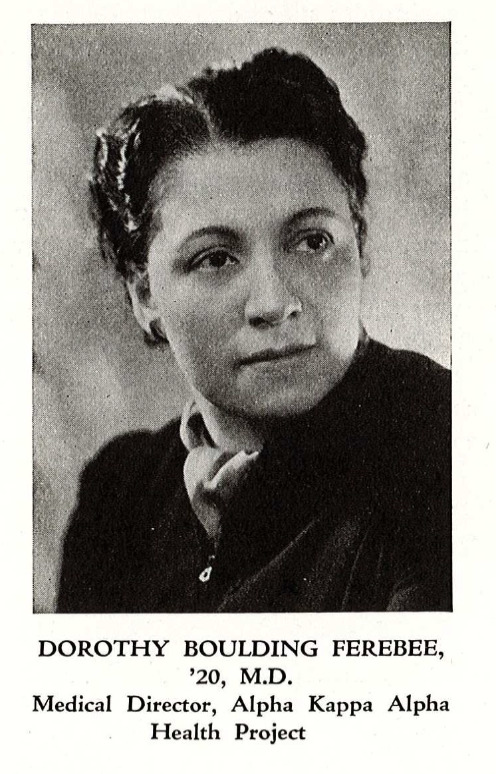
Dorothy Boulding Ferebee
Dorothy Boulding Ferebee graduated from Simmons College in 1920 and completed her medical training at Tufts University School of Medicine in 1924. During her time as a student at Simmons, she joined the Epsilon Chapter of the Alpha Kappa Alpha sorority. This connection endured, and as a practicing physician in the Washington D.C. area, she also became the Medical Director of the Alpha Kappa Alpha sorority's Mississippi Health Project.
In May 1942, the Review published her account of her work with the Mississippi Health Project. For seven summers, she had directed teams of volunteers — physicians, nurses, dentists, dietitians, teachers — driving mobile health clinics into the deep rural Mississippi delta, bringing vaccines, dental care, nutrition instruction, and medical examinations to sharecropper families who had rarely if ever seen a doctor. The work was hard, but its impact was direct: doors lifted off hinges to serve as exam tables; sterilizers set up under trees; and diet lessons taught over charcoal stoves.
Ferebee's article not only celebrated the heroic work of volunteer health clinicians, it also highlighted how the nine million sharecroppers of the cotton-growing South, facing extreme poverty, lack of basic health services, and exclusion from the democratic process, was a contradiction and a national vulnerability. In Ferebee's (1942) words: "total democracy must be extended to the sharecropper area if total defense is to be effective" (p.79). Ferebee was pointing to an uncomfortable truth that, as the nation fought for freedom abroad, it was neglecting the plight of its own people.
In an issue largely united around a story of women's service to uphold the national wartime effort, Ferebee's was a courageous statement about what was neglected and lacking in the nation's call to service. Ferebee also reminded her Simmons readers what a call to action could look like, even when it didn't require a uniform.
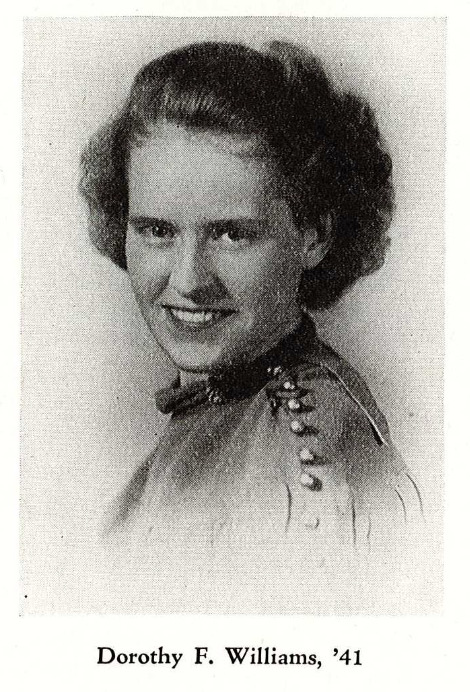
Dorothy F. Williams
In the spring of 1941, months before Pearl Harbor, a graduating senior named Dorothy F. Williams sat down to write about her campus for the Simmons Review. Using a fairy-tale metaphor to make a practical argument, she noted that while a Simmons education didn't choose a direction for you, it gave you the professional footing to travel farther than you could have gone alone. As evidence, she described how the campus had acted on that conviction, with student enrollment in the voluntary Red Cross course attracting more than double its expected numbers.
Six years later, Williams was writing again, not as a student but as an instructor, teaching a course on technical writing she had helped design. Industrial writing and editing was a field with tremendous demand, and the new course was among the first of its kind at a women's college in New England. Each student was "hired" as editor for a fictional company called the Sims Mills and set to work producing actual publications. The guest speakers who came to the class were Simmons graduates already holding editorial positions at major firms. Williams herself was treasurer of the Massachusetts Industrial Editors' Association. She was teaching women to enter a profession she was already helping to lead.
By 1959, she appeared on the masthead of the very magazine she had once written for as a student, listed as Editor of the Simmons Review and, in the same issue, as Assistant Professor of Publishing. Her professional arc was everything the College could have asked for; a Simmons education had given her a direction and the means to pursue it, and she came back to give the same to the students who followed.
References
S.S. Simmons Victory. (1945, May). The Simmons Review, 27(3), 59. https://simmons.access.preservica.com/uncategorized/IO_f57a0ae9-1e13-46f7-bb97-a78f5861eb18/
Coffyn, E.M. (1942, August) The Simmons Clubs and the War Effort. 24(4), 140. https://simmons.access.preservica.com/uncategorized/IO_62898ee4-3057-48c1-8909-d03f9ed90ef4/
Coffyn, E.M. (1944, May) The Launching of a WAVE, 26(3), 55. https://simmons.access.preservica.com/uncategorized/IO_0bc2d976-5fc8-4c73-846b-5e1fe385ac5c/
Ferebee, D. B. (1942, May). Alpha Kappa Alpha Sorority Pleads for Nine Million Defenders of Democracy. The Simmons Review, 24(3), 75-79. https://simmons.access.preservica.com/uncategorized/IO_8571caab-e9f4-46f2-8b29-df4269b38c77/
Williams, D. F. (1947, May). The New Industrial Writing and Editing Course. The Simmons Review, 29(3), 78. https://simmons.access.preservica.com/uncategorized/IO_440c4a07-a725-472e-8a65-342431d857ef/
Williams, D. F. (1941, May). Simmons’ Seven-League Boots. The Simmons Review, 23(3), 4. https://simmons.access.preservica.com/uncategorized/IO_1e02e4e0-4c3d-45da-a369-01e5be9f38ce/