Advocating for 'Revolution, Not Reform'
The 1960s and 1970s were decades marked by a nationwide shift in cultural values, and this is reflected in the Simmons Review. The early 1960s featured articles on balancing family-life and careers in addition to articles on the particular challenges facing women entering the workforce. The anti-Vietnam War and civil rights protests came from powerful social movements and were heavily driven by the youth population. The revolutionary spirit of this period was challenged by an unstable economy and growing cynicism about the possibility of radically altering society in a meaningful way. Not surprisingly, the Review responded with a shift in emphases, including fewer articles on domestic issues affecting alumni and more on new Simmons programs and policies. Attention to social movements, including Women’s Liberation, persisted in its pages, in addition to evidence that students remained committed to social progress through their careers and volunteering efforts.
Marriage and Independence
While Simmons’ founding mission was to provide career-oriented education so women could have the opportunity to gain economic independence, many of the Simmons Review articles from the early 1960s contained the assumption that most, if not all, students would choose to marry during their college years or soon after graduating.
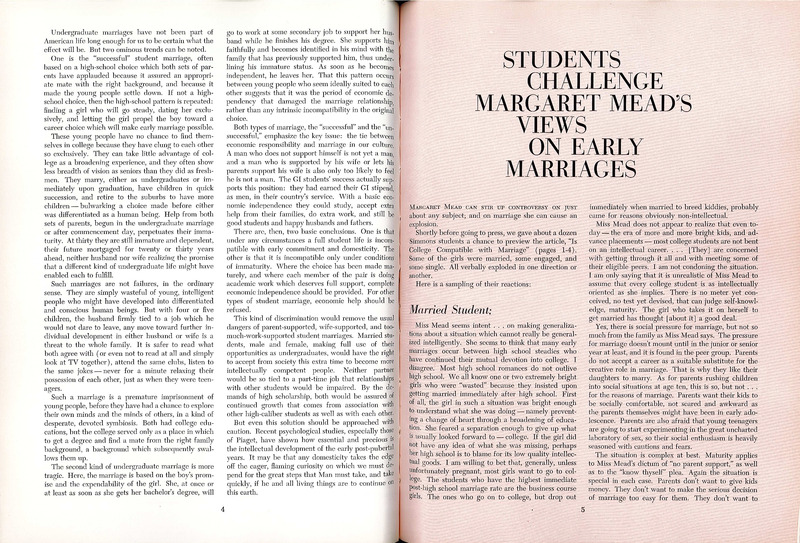
An article by anthropologist Margaret Mead encouraged women to use college as a time to experiment with alternative lifestyles before deciding if marriage was correct for them. That same issue included critical responses from Simmons students, disagreeing with Mead's assertion that women choosing to marry young were not being thoughtful.
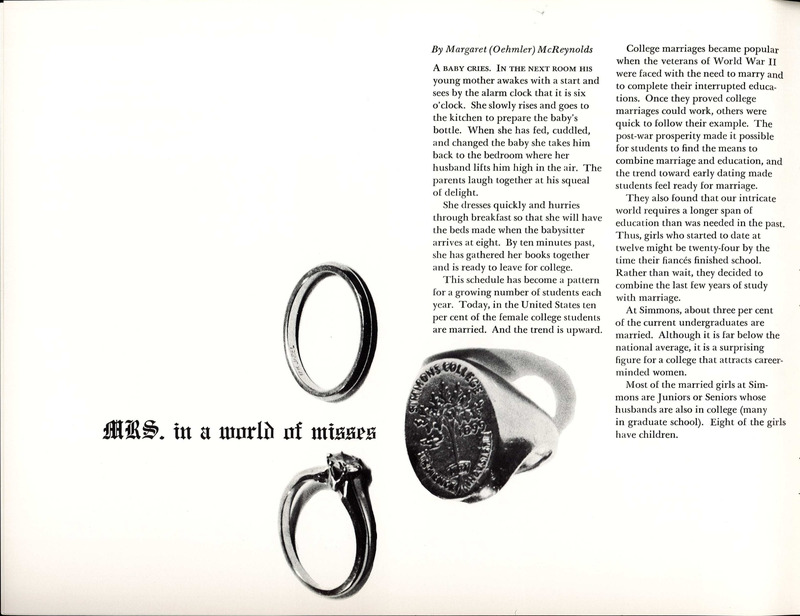
The expectation of marriage was apparent in articles like “The Crisis in Student Morality.” It suggested that the rising trend of premarital sex on campus was a symptom of the broader trend where students attended college just to find a romantic partner. “Mrs. in a World of Misses” presented the experience of students who had already married before graduating. “The Third Phase in a Woman’s Life” was written by the first Director of Continuing Education, Katharine Davis. She emphasized that women could still have choices while being wives and mothers while she summarized Simmons’ new effort to make the college a destination for mothers pursuing a degree after their children required less of their attention.
Following graduation, a questionnaire was sent out to all Simmons alumni to gather a diverse range of information from their current reading habits to their employment details. Questions such as, “Does a Woman Face Special Conflicts?” and “Does a College Education Heighten a Woman’s Ability to Handle Her Home, Husband, Children, and Civic Responsibilities?” were designed to learn more about the balance of home life and outside responsibilities.
The results showed that most respondents felt pressured to fill too many roles at once–home maker, career woman, citizen, and employee–emphasizing the extra, unpaid work expected of women in addition to their careers.
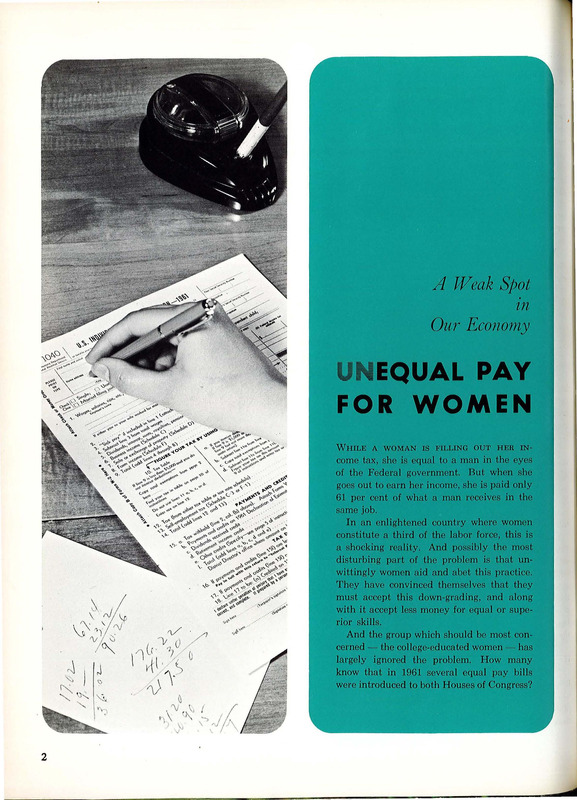
“Unequal Pay for Women” focused on one of the many inequalities women faced in the workplace, as well as the legislation attempting to change that. “Does Simmons Practice What it Preaches on Equal Pay for Equal Work?” addressed other challenges women face in addition to unequal pay, such as sexist hiring practices and the likelihood of men being promoted over women. These issues were foundational in the Women’s Liberation Movement a decade later.
Experimentation in the Curriculum
The end of the 1960s spawned many new ideas from both students and faculty on how to best educate Simmons undergraduates and empower them through education. Some of these experiments did not endure, and others became permanent programs.
The Honors-Pass-Fail system originated as an alternative to traditional letter grading. This system was embraced by both students and newer faculty members wanting a system that encouraged students to fixate less on grades and more on understanding content in a low-pressure environment. It lasted for only four years before being phased out in the 1973-1974 academic year. The system, where students received a “fail” if they did not adequately understand course material, a pass if their knowledge was sufficient, and honors if they excelled made it difficult for graduate schools to evaluate transcripts without letter grades.
It proved difficult for many students and faculty to adjust to a new grading system that was only marginally different than the previous one; and without the pressure to achieve a letter grade, more students started taking five courses instead of four which led to overcrowded classrooms (Ehudin, 1968; Scher, 1969).
The FEED Program, ”Freshman Experiment in Educational Discovery,” started in 1971 as a self-directed, service-oriented program to encourage non-traditional students to create a curriculum that was meaningful for their goals. It was an experiment in taking a student-centered approach to education, in contrast to more traditional seminars, which were self-directed or were about the nature of learning itself. It came to a close four years after being implemented due to a lack of funding from the administration and insufficient non-FEED faculty support.
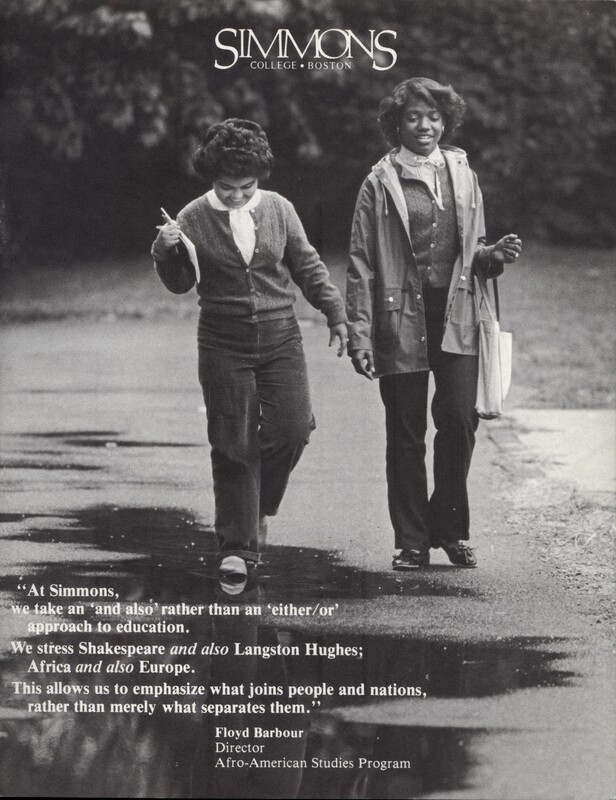
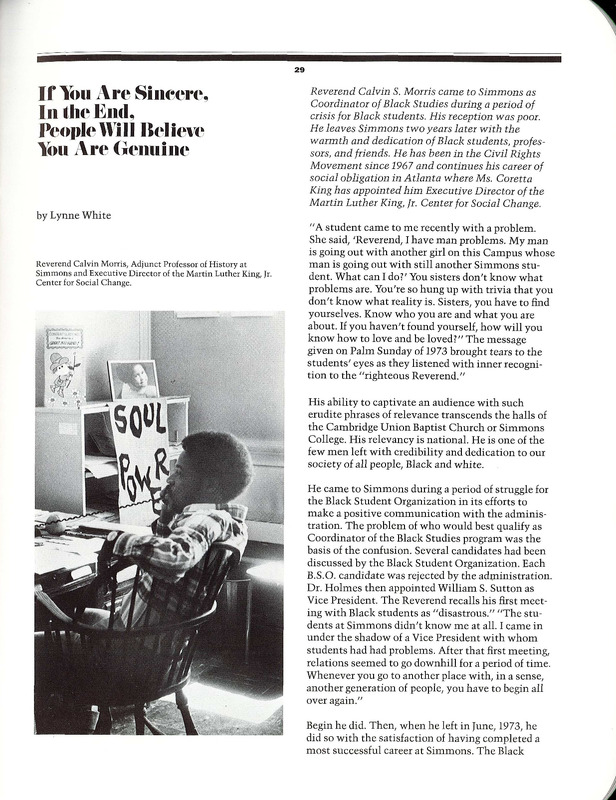
One of the more successful curricular changes was in the creation of the Afro-American (now Africana Studies) program, a department created in response to the demands of the Black Student Organization (BSO) at Simmons and influenced by the larger Black Power movement happening across the country. Although the program coordinator, Rev. Calvin S. Morris, was not a candidate initially approved by the BSO, his slow and methodical planning led to a sustainable program that lasted long after his leave in 1973. The department was designed to be interdisciplinary, bringing black studies curricula into classes on sociology, education, English, history, arts, music, and political ideology.
Another interdisciplinary department started around this time was the Women’s Studies program (now the Department of Race, Gender, and Sexuality Studies). Discussions on creating a woman-centric curriculum were evident in 1972, but no official department was created until the fall of 1974.
As described in the article “Who’s Afraid of Virginia Woolf?”, the department was created in response to the rising number of Women’s Studies programs across the country. New courses in social studies, education, English, law, and sociology were offered that focused on a woman’s role in society. The decision for Afro-American Studies and Women’s Studies to be interdisciplinary departments called attention to how white, patriarchal worldviews affected all disciplines. Acknowledging this bias was a major step in both validating underrepresented perspectives and challenging the universality of traditional schools of thought.
Women’s Liberation
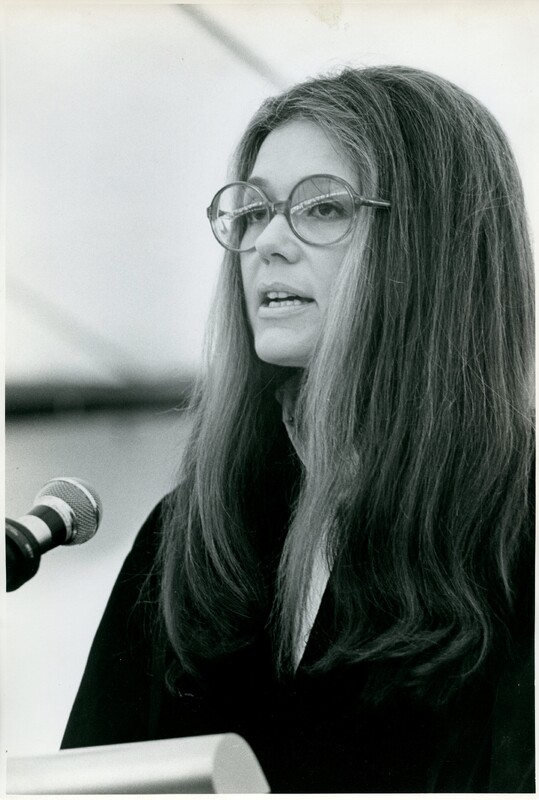
Gloria Steinem, co-founder of Ms. Magazine and thought-leader of second-wave feminism, was Simmons’ commencement speaker in 1973. The Review published an abridged copy of her speech titled “The Women’s Movement Is Revolution, Not Reform”, where she discussed the major issues facing women within a patriarchal society. While the Movement encouraged women to expand their goals beyond homemaking or working in female-dominated industries, this also proved alienating to those with more traditional ambitions. This tension was present in many of the features within the Simmons Review at that time.
In the article “Pressures Created by the Women’s Movement,” a group of Simmons graduate students discussed the benefits and drawbacks of having greater freedom to pursue different lifestyles. Some felt the Movement made them feel less alone regarding the issues and anxieties they faced as women, and less guilty about prioritizing a career over having children. Others felt the Movement pressured them to excel exclusively in their careers despite having goals that included creating a meaningful domestic life (Peterson, 1976). Some felt Women’s Liberation was not relevant to their lived experience and was exclusionary in nature, as discussed in “Why Black Women Do Not Identify with Women’s Liberation”. Writer Barbara Semedo (1972) explained how the Movement primarily spoke to the concerns of White, middle-class women who were participating in the same oppressive structures as White men, and underscored that Black people must liberate themselves as a race first before any issues of sex could be addressed.
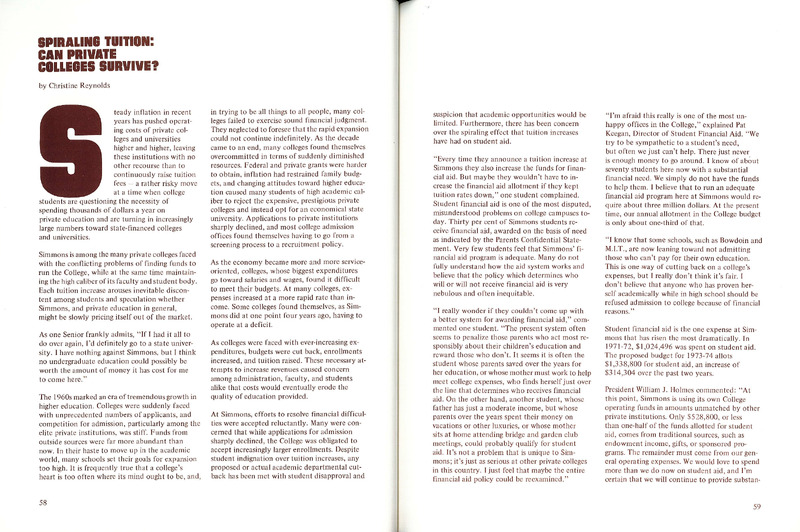
The economic recession in 1973 affected all aspects of American society, especially academic institutions and the workplace aspirations of graduating students. “The New Depression in Higher Education” and “The Tuition Crunch for the Middle Income Student” described how higher inflation and reduced federal funding led to controversial budgeting solutions at Simmons, including limiting tenure positions for faculty and raising tuition costs for students.
Despite rising tuition costs, making a Simmons education affordable for lower-income students remained a priority. “Spiraling Tuition: Can Private Colleges Survive?” described how Simmons allocated more funds to student aid. For the current students, the dismal economy and rampant unemployment were the two major concerns. Articles like “Seniors Challenge a Tight Job Market” and “Tackling the Job Market” described the resources provided by the Placement and Career Planning Offices to prepare students for a less-than-ideal job market. “Arming Alumnae for the Job Skirmish” also highlighted career symposiums and workshops being developed by the Continuing Education, Career, and Placement offices to prepare alumni for the job search and application process .
The Activism of Equality
The revolutionary attitude of the late 60s was replaced by deep cynicism due to the assassinations of Martin Luther King Jr. and Robert F. Kennedy, the Kent State Massacre, Watergate, and the challenging economy, leading many to abandon abstract idealism and focus more on tangible activist work. Simmons received a grant from the Andrew W. Mellon Foundation to integrate a liberal arts education into their career-oriented curricula to prepare students for a profession without sacrificing social awareness.
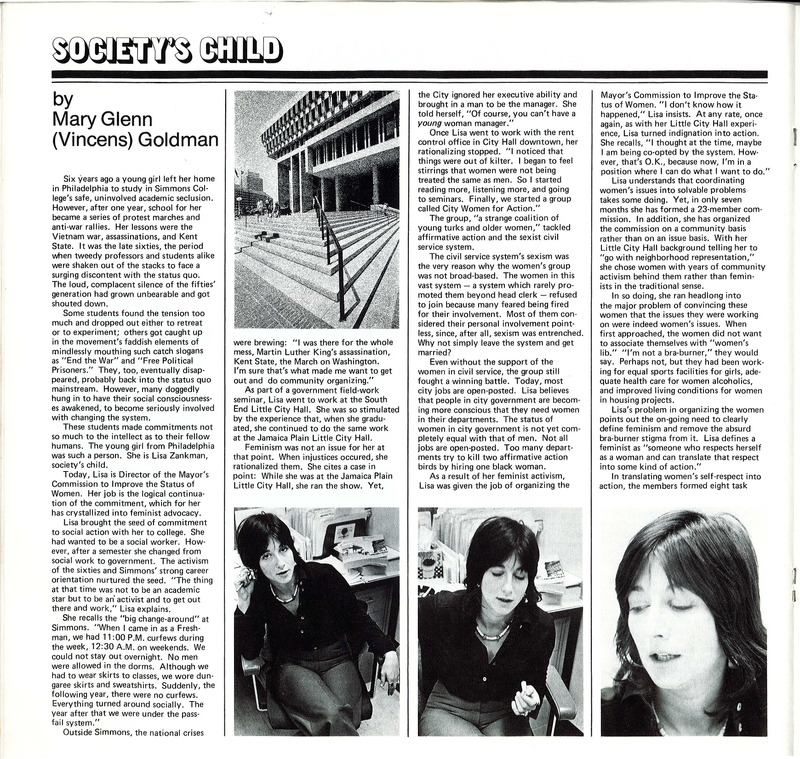
Some attempted to change the system from within, as described in the article “Society’s Child.” In this student profile, Lisa Zankman describes her role in Boston City Hall’s Commission to Improve the Status of Women and how she opted to collaborate with established community organizers doing work to create equal sports facilities for girls, provide adequate healthcare for women dealing with alcohol use disorders, and improve conditions for women in housing projects.
The Supreme Court’s decision on Roe v. Wade led students to become involved in organizations helping women with unintended pregnancies. Some volunteered in organizations like the Pregnancy Council Service, which provided information on abortion clinics as well as offering material resources for those who wished to continue with their pregnancies. One article focused on an alumna who ran a center that provided resources and services to women in challenging situations who chose to carry their pregnancies to term.
References
Albano, A. D. (1972, Late Winter-Early Spring). What will Black Studies be in the light of what Simmons is? Simmons Review, 54(2), 22-24. https://simmons.access.preservica.com/uncategorized/IO_87772ed5-7c12-42ab-ba61-e9648b82b3d0/
Baker, S. (1970, Late Fall-Early Winter). Revolution. Simmons Review, 53(1), 4-5. https://simmons.access.preservica.com/uncategorized/IO_d320678b-a7ff-449e-86e1-98b96e89e696/
Cutler, J. K. (1973, Late Spring-Early Summer). “We’re in charge of our own education”. Simmons Review 53(3), 13-19. https://simmons.access.preservica.com/uncategorized/IO_0b179ea9-5575-4cfc-956c-2bf4f2933749/
Ehudin, A. (1968, Summer). Honors-pass-fail: The making of academic freedom. Simmons Review, 50(4), 10-11. https://simmons.access.preservica.com/uncategorized/IO_44694c6c-b2b3-4d89-ab95-510092a03354/
Friday, A. (1969, Late Fall-Early Winter). The black students’ demands give a new thrust to education at Simmons. Simmons Review, 52(1), 26-28. https://simmons.access.preservica.com/uncategorized/IO_c660a129-c717-43e6-b7e7-0391b6147792/
Goldman, M. G. V. (1975, Late Summer-Early Fall). Society’s child. Simmons Review, 57(4), 18-19. https://simmons.access.preservica.com/uncategorized/IO_01f5b720-1fac-4320-bec1-4546a9ee3fb2/
Grifman, A. (1964, Fall). Does Simmons practice what it preaches on equal pay for equal work? Simmons Review, 47(1), 6-7. https://simmons.access.preservica.com/uncategorized/IO_eec529c8-bc17-422e-a4fd-72af40205226/
Hughes, C. M. (1963, Fall). The third phase in a woman’s life. Simmons Review, 46(1), 17. https://simmons.access.preservica.com/uncategorized/IO_5a0a1e88-c379-4611-be62-e23a11ee400e/
Klein, J. (1975, Late Fall-Early Winter). Putting a finger to the wind. Simmons Review, 58(1), 2-5. https://simmons.access.preservica.com/uncategorized/IO_17d99d90-0c01-4887-b6fa-90d4f72468b5/
Maciel, C. K. (1975, Late Winter-Early Spring). Seniors challenge a tight job market. Simmons Review, 57(2), 8-11. https://simmons.access.preservica.com/uncategorized/IO_99923fa3-c60c-442d-b629-ac0caa218b4b/
McReynolds, M. O. (1964, Winter). Mrs. in a world of misses. Simmons Review, 46(2), 8-9. https://simmons.access.preservica.com/uncategorized/IO_f5b2ce52-fe19-4f61-aa05-64e69af36787/
Mead, M. (1960, Winter). Is college compatible with marriage? Simmons Review, 42(2), 1-4. https://simmons.access.preservica.com/uncategorized/IO_8970c5c0-c7c9-4134-ac40-30e6144ecbd5/
Morris, K. (1976, Late Summer-Early Fall). Tackling the job market. Simmons Review, 58(4), 36-37. https://simmons.access.preservica.com/uncategorized/IO_b8be5af4-2972-4d7b-b2b5-f6014431ec3f/
Needham, J. G. (1960, Fall). Does a woman face special conflicts as wife, mother, homemaker, employee, citizen? Simmons Review, 43(1), 2-5, 13-14. https://simmons.access.preservica.com/uncategorized/IO_34884fa4-4984-4d16-820d-43e274d44f8a/
Needham, J. G. (1961, Winter). Does a college education heighten a woman’s ability to handle her home, husband, children, and civic responsibilities? Simmons Review, 43(2), 2-5, 29. https://simmons.access.preservica.com/uncategorized/IO_6281b595-2576-46d5-b99a-9695887522dc/
Orabona, J. (1975, Late Fall–Early Winter). Why FEED starved to death. Simmons Review, 58(1), 38-41. https://simmons.access.preservica.com/uncategorized/IO_17d99d90-0c01-4887-b6fa-90d4f72468b5/
Peterson, D. R. (1976, Late Summer-Early Fall). Pressures created by the Women’s Movement. Simmons Review, 58(4), 10-11. https://simmons.access.preservica.com/uncategorized/IO_b8be5af4-2972-4d7b-b2b5-f6014431ec3f/
Reynolds, C. (1973, Late Spring-Early Summer). Spiraling tuition: Can private colleges survive? Simmons Review, 55(3), 58-60. https://simmons.access.preservica.com/uncategorized/IO_0b179ea9-5575-4cfc-956c-2bf4f2933749/
Rogovin, J. (1974, Late Spring-Early Summer). The new depression in higher education. Simmons Review, 56(3), 6-9. https://simmons.access.preservica.com/uncategorized/IO_f6af890f-9feb-44dc-94f2-b40f1f8af13b/
Roswit, S. L. (1973, Late Summer-Early Fall). Adviser to the pregnant. Simmons Review, 55(4), 47-50. https://simmons.access.preservica.com/uncategorized/IO_204d480c-da97-4057-a43a-d41f6dfe46b1/
Scher, E. (1969, Late Fall-Early Winter). One year under the honors-pass-fail system. Simmons Review, 52(1), 5-8. https://simmons.access.preservica.com/uncategorized/IO_c660a129-c717-43e6-b7e7-0391b6147792/
Schwartz, P. (1974, Late Spring-Early Summer). The tuition crunch for the middle-income student. Simmons Review, 56(3), 14-15. https://simmons.access.preservica.com/uncategorized/IO_f6af890f-9feb-44dc-94f2-b40f1f8af13b/
Semedo, B. (1972, Late Fall-Early Winter). Why black women do not identify with Women’s Liberation. Simmons Review, 55(1), 25-26. https://simmons.access.preservica.com/uncategorized/IO_9cf9c30a-6241-495e-9d28-67062dc21246/
Sheehan, N. A. (1964, Winter). The crisis in student morality. Simmons Review, 46(2), 6-7. https://simmons.access.preservica.com/uncategorized/IO_f5b2ce52-fe19-4f61-aa05-64e69af36787/
Sherman, M. (1973, Late Summer-Early Fall). Unmarried mother/An alternative to abortion. Simmons Review, 55(4), 54-57. https://simmons.access.preservica.com/uncategorized/IO_204d480c-da97-4057-a43a-d41f6dfe46b1/
Steinem, G. (1973, Late Summer-Early Fall). The Women’s Movement is revolution, not reform. Simmons Review, 55(4), 61-64. https://simmons.access.preservica.com/uncategorized/IO_204d480c-da97-4057-a43a-d41f6dfe46b1/
Students challenge Margaret Mead’s views. (1960, Winter). Simmons Review, 42(2), 5-6, 31. https://simmons.access.preservica.com/uncategorized/IO_8970c5c0-c7c9-4134-ac40-30e6144ecbd5/
Thompson, D. (1975, Late Summer-Early Fall). Arming alumnae for the job skirmish. Simmons Review, 57(4), 5. https://simmons.access.preservica.com/uncategorized/IO_01f5b720-1fac-4320-bec1-4546a9ee3fb2/
Triggs, K. (1972, Late Fall-Early Winter). Where does Simmons stand on Women’s Studies? Simmons Review, 55(1), 17-20. https://simmons.access.preservica.com/uncategorized/IO_9cf9c30a-6241-495e-9d28-67062dc21246/
Unequal pay for women. (1962, Summer). Simmons Review, 44(4), 2-3, 56. https://simmons.access.preservica.com/uncategorized/IO_946bd440-1f2d-4a53-8a76-7453645602a4/
White, L. (1973, Late Summer-Early Fall). If you are sincere, in the end, people will believe you are genuine. Simmons Review, 55(4), 29-31. https://simmons.access.preservica.com/uncategorized/IO_204d480c-da97-4057-a43a-d41f6dfe46b1/
Zimbalatti, L. (1975, Late Fall-Early Winter). Who’s afraid of Virginia Woolf? Simmons Review 58(1), 30-33. https://simmons.access.preservica.com/uncategorized/IO_17d99d90-0c01-4887-b6fa-90d4f72468b5/